
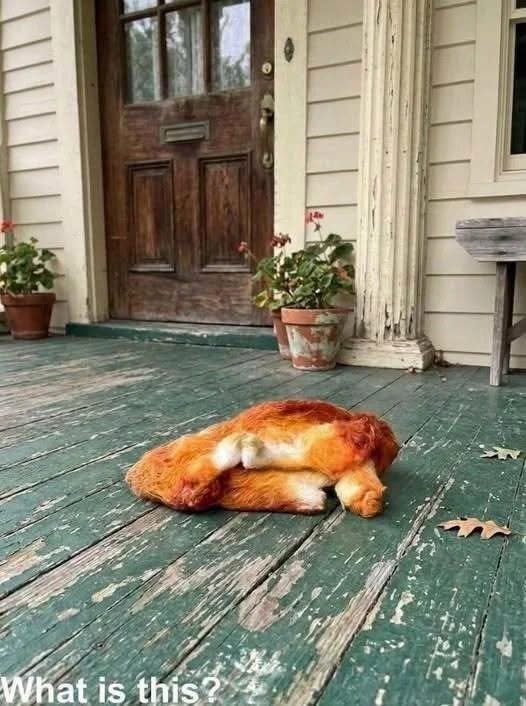
Imagine stepping outside your front door one morning and discovering something you have never seen before. Sitting quietly on your porch is a peculiar orange creature, with an appearance so unusual that you immediately wonder whether it belongs to the natural world.
Is it a rare insect, an unfamiliar animal, or something completely different?
Nature is filled with extraordinary organisms, and some of the most surprising discoveries happen right outside our homes.
But identifying a mysterious orange visitor requires more than its color. Its shape, texture, movement, and surroundings can reveal important clues.
A Mysterious Discovery Right Outside the Front Door
Most homeowners expect to encounter familiar visitors on their porches: birds, butterflies, spiders, or perhaps a curious squirrel.
Finding an unfamiliar orange object or creature is an entirely different experience.
Bright orange coloring can make a small organism look especially dramatic against wooden steps, concrete, or green plants.
Some insects develop vivid colors to warn potential predators. Others rely on camouflage, unusual textures, or seasonal changes in appearance.
And sometimes, what appears to be a living animal is actually an extraordinary natural growth.
That is why the first step in solving the mystery is careful observation.
What Could the Strange Orange Creature Actually Be?
Without a clear photograph or description, no single species can be confirmed. However, several fascinating organisms could explain an unusual orange discovery near a home.
1. An Orange Woolly Bear Caterpillar
One possibility is a woolly bear caterpillar.
These fascinating insects are known for their fuzzy appearance and distinctive coloring.
The familiar banded woolly bear often has black hairs near both ends of its body, with a rusty orange or reddish-brown band around the middle.
Some individuals appear more orange than others.
Woolly bear caterpillars are especially noticeable during autumn, when they move across sidewalks, gardens, and outdoor surfaces searching for protected places to spend the winter.
Despite an old legend suggesting that their bands predict winter weather, scientific research has not supported that claim.
2. A Fuzzy Caterpillar That Should Not Be Touched
Not every soft-looking caterpillar is harmless.
The southern flannel moth caterpillar, often called the puss caterpillar, has a dense, furry appearance that can make it resemble a tiny piece of fabric.
Hidden beneath its hairs are venomous spines capable of causing painful reactions.
Although these caterpillars are generally tan, grayish, or brownish rather than bright orange, lighting and photographs can sometimes make their coloring appear different.
If the mysterious visitor looks unusually furry, the safest choice is to observe it without touching it.
3. A Bright Orange Slug
Another possible explanation is an orange slug.
Slugs are soft-bodied mollusks that commonly appear in damp environments, especially after rainfall.
Certain species display orange, reddish-brown, or rusty coloration.
Their elongated bodies, slow movement, and moist appearance make them relatively easy to distinguish from caterpillars.
A slug may wander across a porch while searching for food or shelter, particularly during humid weather.
4. An Unusual Slime Mold
Perhaps the most surprising possibility is that the orange object is not an animal at all.
Slime molds can appear as bright yellow or orange masses on decaying wood, mulch, soil, and other damp organic surfaces.
Some look like foam, scrambled eggs, or strange blobs from a science-fiction movie.
Despite their unusual appearance, many common landscape slime molds are harmless to garden plants.
They feed on microorganisms associated with decomposing organic matter and may appear suddenly after wet weather.
A mysterious orange mass that stays in one place and gradually changes shape or dries out could be a slime mold rather than an insect.
Why Would Such an Unusual Creature Appear on a Porch?
Porches provide conditions that attract a surprising variety of organisms.
During rainy weather, moisture may encourage slugs and other small animals to explore nearby surfaces.
Porch lights can attract moths and other insects, while garden plants provide food and shelter for caterpillars.
Wooden structures, fallen leaves, and mulch can also create favorable conditions for fungi and slime molds.
Temperature changes are another important factor.
As seasons change, some creatures search for protected places where they can avoid extreme weather.
A porch may simply offer a convenient resting place during that journey.
Is the Orange Creature Dangerous?
The answer depends entirely on what has been found.
Many common garden creatures are harmless when left undisturbed. However, some caterpillars possess irritating hairs or venomous spines.
For that reason, homeowners should avoid handling unfamiliar organisms until they have been properly identified.
A few simple precautions can help:
- Keep children and pets away from unidentified creatures.
- Take a clear photograph from a safe distance.
- Avoid crushing, squeezing, or handling unfamiliar insects.
- Do not taste or touch unidentified fungi or slime molds.
- Consult a local wildlife specialist or university extension service if identification remains uncertain.
If contact with an unfamiliar creature causes severe pain, significant swelling, difficulty breathing, or another concerning reaction, seek medical assistance.
How to Identify a Strange Orange Visitor
Solving the mystery often begins with a few important observations.
Examine its shape. Does it have a long segmented body, a rounded form, visible legs, or no obvious body structure?
Look at the texture. Is the surface hairy, smooth, slimy, or powdery?
Watch for movement. A caterpillar crawls using its legs and prolegs, while a slug glides along a muscular foot. Slime molds change position much more slowly.
Consider the surroundings. An organism found beside damp mulch may be different from one discovered on a dry wall.
Notice the season. Some caterpillars are especially visible in autumn, while other organisms become more noticeable after warm, wet weather.
These details can make identification far more accurate than color alone.
Could the Photograph Be Artificially Generated?
There is another possibility worth considering, particularly when the discovery comes from social media rather than a personal encounter.
Modern image-generation technology can produce convincing pictures of extraordinary animals that do not actually exist.
A photograph showing an orange creature with unrealistic facial features, unusual anatomy, or an exaggerated cartoon-like appearance may be digitally created.
However, strange appearance alone does not prove that an image is fake.
Before sharing a dramatic discovery as a genuine wildlife encounter, it is worth checking the original source and looking for supporting photographs or credible identification.
Why Strange Creatures Fascinate Us
Part of the excitement surrounding mysterious animals comes from the realization that nature is far more diverse than most people imagine.
A tiny caterpillar can resemble a plush toy.
An unusual slug can look like an alien visitor.
A slime mold can appear almost overnight, creating an orange mass that seems impossible to explain.
These discoveries remind us that even familiar environments can contain unfamiliar forms of life.
They also offer an opportunity to learn more about the important roles small organisms play in local ecosystems.
Final Thoughts: A Strange Visitor With a Natural Explanation?
Discovering a mysterious orange creature on the porch can be surprising, fascinating, and sometimes a little unsettling.
But unusual does not necessarily mean dangerous.
The visitor could be a caterpillar, a slug, an extraordinary slime mold, or another organism entirely. If the discovery exists only in an online photograph, digital image creation is also worth considering.
The important thing is to avoid jumping to conclusions without enough evidence.
Sometimes, the strangest-looking discoveries turn out to be perfectly ordinary parts of nature.
Have you ever discovered an unusual creature near your home? What did it look like? Share your experience in the comments!