
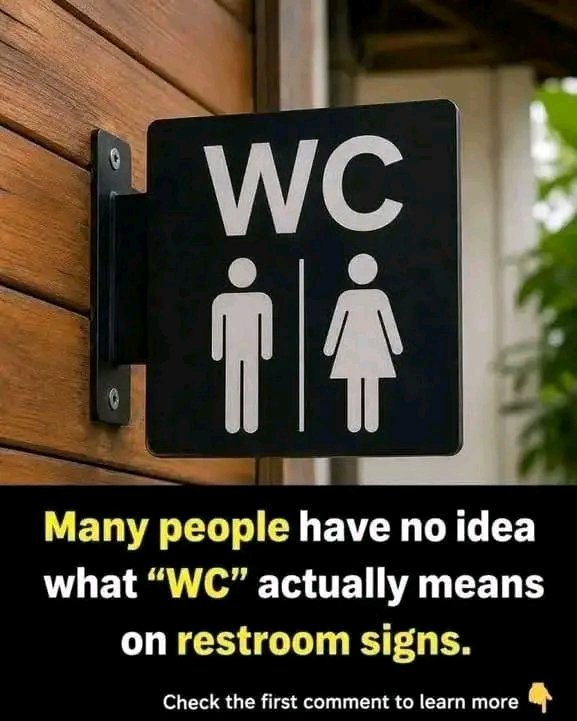
What Does “WC” Actually Stand For? The Toilet Sign Mystery Finally Solved!
Have you ever walked through a hotel, restaurant, airport, or shopping center and noticed a sign marked WC? You probably recognized it immediately as a restroom, but have you ever wondered what those two letters actually mean?
The answer is surprisingly simple: WC stands for “Water Closet.”
Although the term may sound unusual today, it has a fascinating history that dates back to the early days of indoor plumbing. Here’s how this abbreviation became a familiar sign around the world.
What Does WC Mean?
WC is short for Water Closet, a traditional English term for a small room containing a toilet.
The word “water” refers to the water-based flushing system, while “closet” historically meant a small private room or enclosed space.
Before modern indoor plumbing became widespread, toilets were often located outside the main house. As indoor plumbing developed, dedicated rooms containing flushing toilets became more common, and the expression “water closet” helped distinguish them from other household spaces.
Today, WC remains a widely recognized abbreviation, particularly in Europe and in places influenced by European terminology.
How Did the Term Water Closet Begin?
The expression became associated with the development of indoor sanitation in Britain during the 18th and 19th centuries.
As plumbing technology advanced, water-flushed toilets gradually replaced or supplemented older sanitation arrangements. The term “water closet” described the enclosed space where this new type of toilet was installed.
Over time, the abbreviation WC appeared on signs, architectural plans, public buildings, and travel facilities.
Although the technology has changed considerably, the abbreviation has survived.
Why Do Some Countries Say WC Instead of Bathroom?
Different countries use different words for the same basic facility.
Here are some common examples:
- WC: Water Closet; commonly seen on signs in many European countries.
- Restroom: Common in the United States, particularly in public places.
- Bathroom: Widely used in American English, even when a room contains no bathtub.
- Toilet: Common in British English and many other varieties of English.
- Lavatory: A more formal term often associated with aircraft, ships, and public facilities.
- Washroom: Frequently used in Canada and other English-speaking settings.
The preferred term depends on local language and cultural habits. None of these expressions is universally used everywhere.
Is a WC Different From a Bathroom?
Sometimes, yes.
Traditionally, a water closet refers specifically to a small, separate room containing a toilet. A bathroom generally refers to a room with bathing facilities, such as a bathtub or shower, and may also contain a toilet and sink.
In modern homes, a separate WC can be useful because one person can use the toilet while another uses the bathroom.
However, the meaning varies by country, building design, and everyday usage.
Why Is WC Still Used Today?
There are several practical reasons the abbreviation remains popular.
1. It is short. Two letters are easy to recognize on signs in busy public places.
2. It crosses language barriers. International travelers may recognize WC even when they do not speak the local language.
3. It has a long history. The abbreviation is well established in public signage, travel facilities, and building layouts.
4. It saves space. Compact signs are useful in airports, stations, restaurants, hotels, and shopping centers.
Even though many people no longer use the full expression “water closet” in ordinary conversation, the abbreviation continues to serve a practical purpose.
Interesting Fact: WC Does Not Always Mean a Separate Room
On a sign, WC usually indicates a toilet facility. It does not necessarily tell you whether the room contains a sink, shower, or other amenities.
In architectural plans, however, WC may refer specifically to a toilet room, depending on the conventions used by the designer.
If you’re traveling internationally, look for additional symbols or signs indicating accessible facilities, family restrooms, or separate men’s and women’s facilities.
Final Thoughts
The next time you see a WC sign, you’ll know exactly what it means: Water Closet, a term rooted in the history of indoor plumbing.
What began as a description of a small room containing a water-flushed toilet has become a simple, internationally familiar abbreviation.
Sometimes, the most ordinary signs around us have the most interesting stories behind them!
Did you already know what WC stands for, or did you think it meant something else? Share this article with someone who might find the answer surprising!
Tighten the repetitive sectionsAdd SEO metadata for WordPress